



Facial recognition has fundamentally changed how governments evaluate passport photos. Modern passport systems no longer rely only on visual inspection by human reviewers.
Instead, biometric algorithms, computer vision systems, and machine learning models analyze facial images mathematically to determine whether they are suitable for identity verification. This shift has transformed passport photography into a technical discipline centered around biometric consistency rather than aesthetics.
A passport photo is now expected to function as machine-readable identity data that can be compared accurately across immigration systems, airport checkpoints, government databases, and automated border control infrastructure. Because of this, many traditional assumptions about photography no longer apply.
What looks visually attractive or "professional" does not necessarily improve biometric accuracy. In some cases, visually enhanced images actually reduce recognition reliability.
Understanding what truly matters for facial recognition explains why governments enforce strict rules around lighting, positioning, facial expression, image quality, and background uniformity.
Facial Recognition Does Not "See" Faces Like Humans Do
Human beings recognize faces holistically. A person can identify someone even under poor lighting, unusual angles, or partial obstruction because the human brain compensates for visual inconsistencies naturally.
Facial recognition systems operate differently.
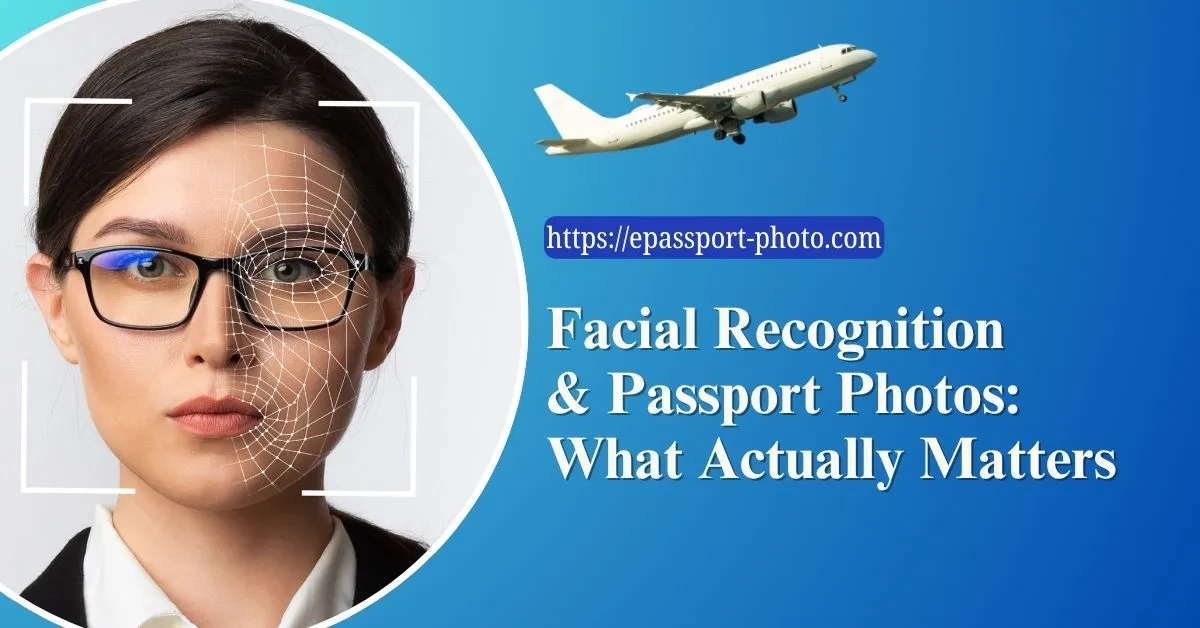
Computer vision systems convert faces into measurable mathematical structures. Instead of interpreting appearance emotionally or contextually, algorithms analyze:
Landmark coordinates
Contrast gradients
Structural symmetry
The system identifies patterns across measurable facial regions and transforms them into biometric representations that can be compared numerically. This means facial recognition depends heavily on image consistency and technical precision.
The Core Principle: Facial Geometry
The most important factor in biometric facial recognition is facial geometry.
Facial geometry refers to the structural relationships between key facial landmarks, including:
Eye centers
Nose bridge
Nose tip
Mouth corners
Jawline boundaries
Chin contour
Forehead proportions
Facial recognition systems measure distances, ratios, and angular relationships between these landmarks.
For example, algorithms evaluate:
Distance between the eyes
Nose-to-mouth ratio
Eye-to-chin proportion
Facial width relative to height
These relationships create a biometric facial signature unique to each individual. Because facial recognition depends on geometric stability, passport photos must preserve accurate facial proportions without distortion.
Why Camera Distance Matters More Than Camera Quality
Many users assume that higher camera quality automatically improves passport photo accuracy. In reality, camera distance often matters more than megapixel count.
When a camera is positioned too close to the face, perspective distortion occurs.
This distortion causes:
The nose to appear larger
Facial edges to curve unnaturally
Forehead proportions to change
Jawline geometry to shift
While these distortions may appear subtle visually, biometric systems analyze faces mathematically and detect these geometric inconsistencies precisely.
Professional passport photography uses controlled camera distance specifically to preserve natural facial proportions.
This is also why selfies frequently fail biometric standards. Smartphone front cameras are typically held too close to the face, introducing wide-angle distortion.
The Scientific Importance of Eye Position
Eye positioning is one of the most critical variables in facial recognition systems.
Most algorithms use the eyes as primary normalization anchors during facial alignment. Before comparing faces, the system rotates and scales the image mathematically so that the eyes align with standardized coordinates.
If eye positioning varies excessively:
Facial normalization becomes unstable
Landmark consistency decreases
Recognition confidence drops
Governments therefore specify strict eye position ranges within passport photos. The objective is not visual balance. It is algorithmic consistency.
Why Neutral Facial Expressions Improve Recognition Accuracy
Facial expressions significantly alter facial geometry.
Smiling changes:
Cheek elevation
Mouth curvature
Eye shape
Jaw tension
Nasolabial fold structure
These muscular changes modify the spatial relationships between landmarks.
Facial recognition systems perform best when facial geometry remains stable and repeatable. Neutral expressions reduce muscular deformation and create more consistent biometric mapping across:
Passport photos
Airport scans
Immigration databases
Border checkpoints
This is why exaggerated expressions are discouraged or prohibited in official passport standards.
Lighting and the Physics of Facial Recognition
Lighting affects facial recognition at both optical and computational levels.
Human observers compensate naturally for uneven illumination. Machine vision systems rely directly on pixel intensity distributions and edge gradients.
Facial recognition algorithms analyze:
Surface contours
Contrast transitions
Reflectance patterns
Shadow boundaries
Uneven lighting alters these measurements.
For example:
Side lighting exaggerates one side of the face
Shadows obscure landmark visibility
Overexposure removes edge detail
Bright reflections distort surface gradients
Even minor lighting inconsistencies can reduce landmark detection accuracy.
This explains why passport standards require:
Soft lighting
Uniform exposure
Minimal shadows
Natural contrast balance
The objective is to reduce optical variability before biometric processing begins.
Why Image Resolution Matters Scientifically
Resolution determines how much facial information exists within the image.
Biometric systems depend on fine structural detail for:
Landmark precision
Texture analysis
Edge detection
Geometric mapping
Low-resolution images reduce:
Spatial accuracy
Landmark reliability
Recognition stability
According to image sampling theory, insufficient pixel density causes important facial structures to become underrepresented or blurred.
For example:
Eyelid contours may merge
Nose edges may lose precision
Hairline boundaries may disappear
This is why governments enforce minimum resolution requirements and discourage aggressive image compression.
Compression Artifacts and Biometric Failure
Most digital images use JPEG compression to reduce file size. Compression algorithms remove image data considered visually unimportant to humans.
However, biometric systems depend heavily on subtle high-frequency information.
Compression artifacts can:
Blur edge transitions
Distort texture patterns
Reduce landmark clarity
Introduce artificial gradients
An image that appears visually acceptable may still fail biometric validation because compression has altered the mathematical structure of facial detail.
This is one reason heavily compressed mobile passport photos are commonly rejected.
Why Background Uniformity Actually Matters
Many people believe the background is only a cosmetic requirement. Scientifically, the background plays an important role in segmentation.
Before facial analysis begins, the system must isolate the subject from the surrounding environment.
This process relies on:
Edge detection
Contrast segmentation
Contour extraction
Complex or inconsistent backgrounds interfere with:
Hairline separation
Shoulder detection
Facial edge mapping
A uniform white or light-colored background simplifies segmentation mathematically and improves contour extraction accuracy.
This is why shadows behind the head often cause rejection. They disrupt boundary consistency between subject and background.
How AI and Deep Learning Changed Passport Verification
Traditional facial recognition systems relied primarily on geometric measurement models.
Modern systems increasingly use deep learning architectures trained on massive facial datasets. These systems generate:
Facial embeddings
Statistical identity vectors
Deep feature representations
Instead of analyzing only distances between landmarks, deep neural networks learn complex facial identity patterns from millions of examples.
However, even advanced AI systems still require standardized input quality. Extreme variation in lighting, pose, expression, and resolution reduces model reliability.
Passport standards therefore exist partly to minimize environmental variability before AI analysis occurs.
Why Beauty Filters and AI Enhancements Reduce Recognition Reliability
Modern smartphone cameras frequently apply computational enhancements automatically.
These enhancements may:
Smooth skin texture
Alter facial symmetry
Brighten eyes artificially
Sharpen contours
Modify facial proportions subtly
While these effects improve social photography aesthetically, they interfere with biometric consistency.
Facial recognition systems compare stable structural identity patterns. Artificial enhancement changes those patterns and can reduce recognition confidence during comparison.
This is why governments increasingly reject heavily filtered passport photos.
The Relationship Between Passport Photos and Border Control Systems
Passport photos are not isolated images. They function within broader biometric ecosystems.
Modern border control systems compare:
Passport photo databases
Live facial scans
E-passport chip data
Immigration records
Historical biometric templates
The passport photo therefore serves as a foundational biometric reference image used across multiple systems and years of identity verification.
Consistency becomes critically important because recognition must remain reliable:
Across aging changes
Under different lighting conditions
Across international databases
This explains why governments prioritize technical standardization over artistic photography.
What Actually Matters Most for Facial Recognition
From a scientific and biometric perspective, the most important variables are:
Natural facial geometry
Correct camera distance
Uniform lighting
Stable facial expression
Accurate eye alignment
Sufficient resolution
Minimal compression
Background consistency
Interestingly, many things people focus on visually, such as artistic composition or cosmetic appearance, matter very little to biometric systems.
Recognition accuracy depends primarily on structural consistency and mathematical reliability.
Why Structured Passport Photo Processing Improves Acceptance Rates
Because facial recognition systems evaluate technical biometric properties rather than visual attractiveness, reliable passport photo preparation requires structured processing.
Accurate preparation involves:
Geometric normalization
Landmark-aware alignment
Resolution preservation
Compression control
Background standardization
Proportion correction
Platforms like Epassport-Photo help optimize these variables according to official document standards rather than generic visual editing rules.
This significantly improves compatibility with real-world biometric verification systems used in passport, visa, and immigration processing.
Conclusion
Facial recognition systems analyze passport photos scientifically rather than visually. Modern biometric verification depends on geometric consistency, landmark precision, image normalization, and stable facial structure rather than aesthetic quality.
This is why passport photo requirements are highly technical and standardized. Variables such as camera distance, eye positioning, lighting uniformity, resolution, and background consistency directly influence how accurately facial recognition systems can map and compare identities.
As biometric systems continue evolving through AI and machine learning, passport photos will remain essential machine-readable identity assets within global verification infrastructures.
Visit EPassport-Photo
Download the App | Android | IOS |
Frequently Asked Questions (FAQs)
1. What matters most in facial recognition passport photos?
Accurate facial geometry, lighting consistency, eye alignment, and sufficient image resolution.
2. Why are selfies bad for passport photos?
Selfies often create perspective distortion because the camera is too close to the face.
3. Can beauty filters affect facial recognition?
Yes. Filters alter facial structure and texture patterns used in biometric analysis.
4. Why is lighting so important in biometric systems?
Lighting affects edge detection, landmark visibility, and surface gradient analysis.
5. Do facial recognition systems use AI?
Yes. Modern systems increasingly rely on deep learning and machine learning models